
DC Simulations
Grøft Design® supports Direct Current (DC) cable systems in addition to AC. DC has its own cable category, so a DC cable carries its own electrical and thermal properties in the same way as an AC cable.
Support for DC covers:
- Ampacity Constraints: Rating of DC cables against both thermal limitations and insulation constraints (maximum temperature drop over the insulation).
- Dynamic Rating: Time-dependent load profiles enable dynamic rating of DC cables, allowing dimensioning to be optimized against actual load cycles rather than worst-case steady-state assumptions.
- Interface of AC and DC: Grøft Design® supports calculation of the thermal interaction between AC and DC cables installed in the same trench or duct bank. Grøft Design® simulates the electromagnetic and thermal effects for AC, while assuming pure joule losses for DC, to capture the mutual heating effect that derates adjacent AC/DC installations.
Grøft Design® has been validated against CIGRE Technical Brochure 880 (Power Cable Rating Examples for Calculation Tool Verification), Case Study 7: a 320 kV HVDC submarine bipole.
Adding a DC Cable
Section titled “Adding a DC Cable”When adding a cable to a trench cross-section, choose Cable (DC) from the Category drop-down in the add… dialog, alongside HV Cable (AC) and LV cable (AC).
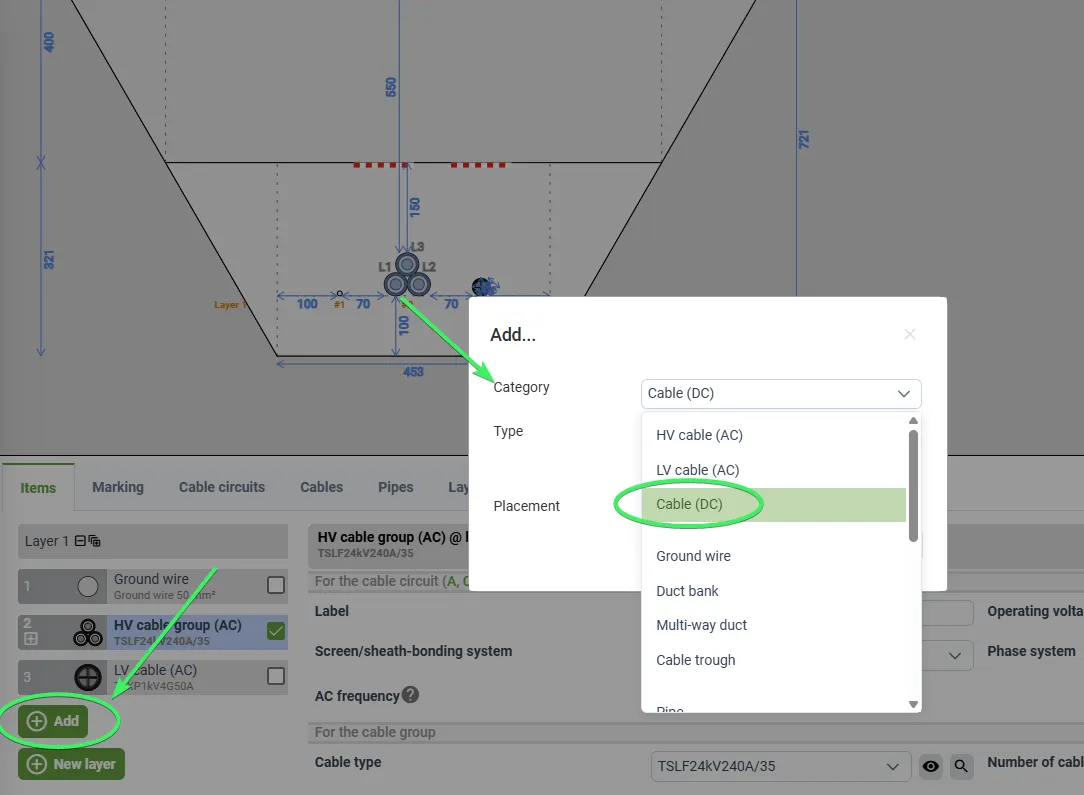
A cable can also be tagged for use in both AC and DC circuits, so the same cable definition can serve either circuit type without duplicating it in the component database.
Combining AC and DC Cables
Section titled “Combining AC and DC Cables”Because DC is simply another cable category, AC and DC cables can be freely combined within the same trench cross-section or duct bank. This makes it possible to model, for example, a DC link routed alongside existing AC circuits and calculate the thermal interaction between them.
Magnetic Field Results
Section titled “Magnetic Field Results”Result plots and reports show only the AC magnetic field — the field from a DC cable is not included, since it is the alternating field that is relevant for induction into nearby infrastructure and for regulatory field-strength requirements.